


Posts Global Market Baowu Steel 6 02 September 2026
Europe’s automotive industry is showing good development momentum this year
The situation in the European automotive industry serves as a good indicator of the health of the entire EU economy. Over the past few years, growth in this sector began only in August 2022 and is continuing to this day. However, forecasts for the future of the European auto industry are conflicting.
Industry dynamics
The importance of the automotive industry for the EU economy is hard to overestimate. The size of the auto sector accounts for 7% of the EU’s total GDP. In Germany, 42 car plants operate, in France – 31, in Italy – 23, and in Spain – 17 production facilities. In 2022, 46% of Slovakia’s exports outside the EU were cars. In other words, the “well-being” of the European auto industry depends to a large extent on positive trends both in the European Union’s economy and in the individual countries that make it up.
According to the European Automobile Manufacturers’ Association (ACEA), in 2022 were made 10.9 million passenger cars in the EU, which is 8.3% higher than in 2021. Recall that in 2021 there was a decline of 6.7%. In 2022, the EU increased car exports by 24.4% – to €158 billion, imports – by 14.8%, to €62 billion. Germany became the largest exporter, shipping cars worth €92 billion, or 59% of the total European figure.
Over the past year, 9.3 million new passenger cars were registered in the EU, which is the lowest figure since 1993 (9.2 million vehicles). In 2022, the EU car market shrank by 4.6%, mainly due to component shortages in the first half of the year. Among the four largest EU markets, only Germany finished the year in positive territory – growth compared to 2021 was 1.1%.
Останні три ринки також показали зниження: Італія – -9,7%, Франція – -7,8% та Іспанія – -5,4%.
Але з серпня по грудень 2022 року на європейському ринку почалася позитивна динаміка, яка продовжилася і в 2023 році.
“Over the first five months of 2023, passenger car production in the region increased by 25% year on year. Although orders for new cars in Germany fell by 8% year on year in January–May, there is a huge deferred demand there, with delivery lead times reaching up to 12 months,” says GMK Center Chief Analyst Andriy Tarasenko.
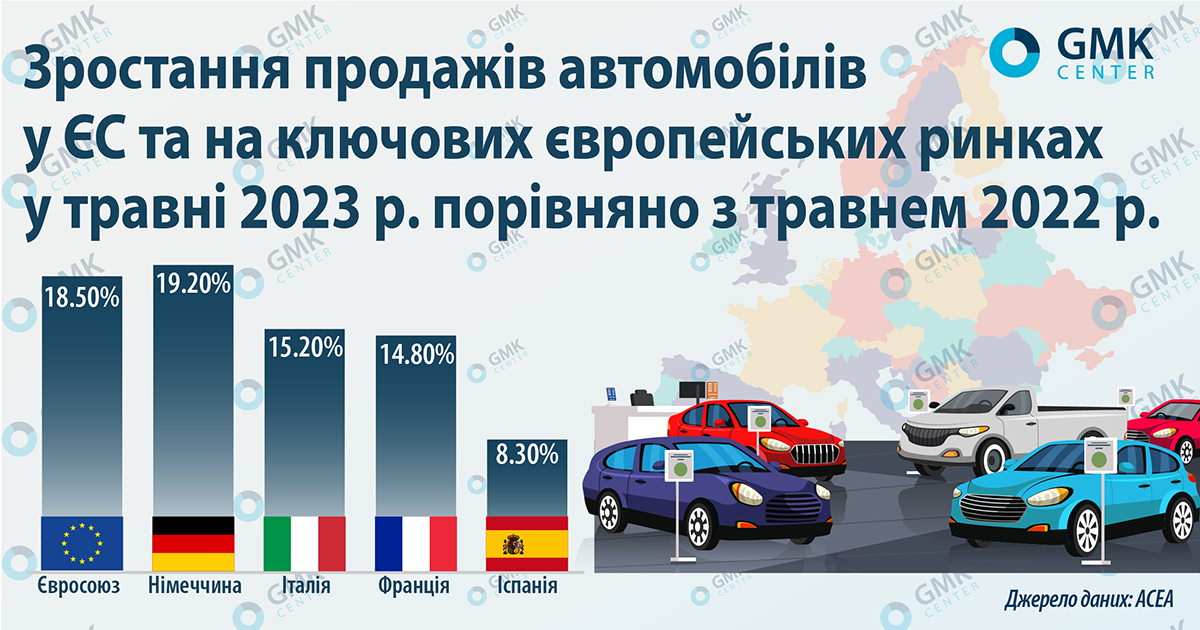 Passenger car sales in the EU in May 2023 increased by 18.5% to 939 thousand units. All of the largest EU markets showed solid sales growth in May: in Germany it was 19.2%, in Italy – 15.2%, in France – 14.8%, and in Spain – 8.3%.Overall, passenger car sales in the European Union in January–May increased by 18% year on year to 4.4 million, while in Europe overall they grew by 17.4% to 5.324 million.
Automotive trends
Among the main trends in Europe’s automotive industry, the following can be highlighted:
- A significant reduction in the semiconductor shortage for the auto industry.The semiconductor shortage was a major issue in 2021, but its significance declined in 2022–20023.
- High inflation and rising interest rates.This cuts real household budgets, and the rise in interest rates makes cars more expensive.Credits are also more expensive.Potential weakness in demand may complicate the auto industry’s recovery.
- Growth in production and sales of electric vehicles, and a gradual decline in the share of internal combustion engine vehicles.According to LMC Automotive analysts, electric vehicles accounted for 11% of new car sales in Europe in 2022.
Питома вага електрокарів у Європі у травні поточного року зросла до 13,8% порівняно з 9,8% роком раніше.
Overall, in 2022 global sales of electric vehicles increased by 55% and exceeded 10 million vehicles.
The share of electric cars in total car sales stood at 14% in 2022 and could reach 18% by the end of the current year.
The EU authorities have agreed to phase out such vehicles by 2035, with the exception of Germany, which has set a course for «synthetic fuel». By that deadline, the use of gasoline and diesel vehicles, as well as hybrids, will be banned. They will give way to electric cars, except for those that will run on synthetic fuel. In other words, the EU authorities’ regulation requires that by 2035 new vehicles produced in Europe have no CO2 emissions.
«The automotive sector could become one of the first leading markets that stimulate demand for low-CO2 steel products. In turn, this could help steel producers gain confidence in investing in low-emissions steel production and also reduce emissions across the supply chain of the automotive sector,» emphasize in the EUROFER Association.
Steel for the automotive industry
On the one hand, steel consumption in the EU in 2023 will decline due to issues in the construction sector. On the other hand, demand for steel will be supported by a moderate recovery in the automotive industry.
In the automotive sector, consumption of metal products increased by 3.3% annually over 2021-2022, but in 2023 a slowdown is expected in the rate to 1.2% due to changes in steel demand and supply in the market.
У 2024 році очікується падіння попиту на сталь з боку автомобільного сектора на 1.8% year-on-year (y/y). За оцінками EUROFER, автомобільний сектор загалом забезпечує 17% споживання сталі в ЄС і демонструє хороше зростання.
«Попит на сталь може збільшитися за рахунок зростаючої кількості електромобілів, які будуть вироблятися в найближчі роки. WorldAutoSteel, автомобільна група Всесвітньої асоціації виробників сталі, оцінює, що для електромобіля може знадобитися на 260-280 кг більше сталі, ніж для автомобіля із двигуном внутрішнього згоряння, для якого потрібно близько 900 кг сталі», – відзначають в Argus.
Outlook for the EU automotive industry
Sentiment in the European automotive industry was positive in the first quarter. However, in the second half of the year, EU automakers are preparing for stronger competition and lower demand.
«Європейські автовиробники мали значні портфелі замовлень на другий квартал, і очікується, що до третього кварталу попит та пропозиція вирівняються після нормалізації проблем з боку пропозиції. Усунення перешкод у логістиці та ланцюжках поставок у поєднанні з очікуваним зниженням кількості замовлень змушує окремих автовиробників готуватися до посилення конкуренції», – повідомляють в Argus.
ACEA прогнозують ріст авторинку Євросоюзу на 5% у 2023 році до майже 10 млн автомобілів (рівень 2020 року).
In turn, GMK Center expects a 5% increase in car production in the EU this year, the same as for the previous period, while in Germany the growth will be even higher – 9%.
“The sector will continue to show moderate growth after very low production volumes over several quarters, but absolute production volumes will remain significantly lower than the levels seen in 2018 (the peak of the previous cycle), even in 2024. In the EU automotive sector, moderate growth (+1.2%) is expected in 2023 thanks to moderately positive changes on both the supply and demand sides. However, production volumes are forecast to fall again in 2024 (-1.8%),” –EUROFER notes.
Ukraine’s ferrous metals industry is an important element in the value-added chain of Europe’s automotive industry. Mining companies supply the EU with corrosion-resistant steel (CRS), from which local steelmakers produce automotive steel. Ukrainian producers manufacture stainless steel pipes for this industry. The health of the European economy and the state of the automotive sector also determine Ukraine’s export-oriented ferrous metals industry.

-

02 September 2026

01 May 2025
22 April 2025

19 July 2023