The country's parliament has again voted in favour of the decision, and the company supports continued investment in France.
In June this year, the lower house of the French parliament (the National Assembly) for a second time backed the nationalisation of ArcelorMittal’s assets. The company called this «the wrong decision» and once again reaffirmed its development plan in the country.
Second attempt
In the second reading, the bill was backed by all left-wing parties, while the right and members of Macron’s party opposed it, and the National Rally (RN) abstained.
As stated in the text of the document, the bill is aimed at nationalising ArcelorMittal France in order to preserve the country’s industrial sovereignty. An administrative commission is to be set up to determine the price at which the state will acquire the company. At the same time, that amount may not exceed the average actual value of the company’s shares from 1 October 2024 to 30 September 2025.
Nationalising ArcelorMittal France is estimated to cost €3 billion.
The bill, introduced by La France Insoumise (LFI), was already approved in the first reading in November 2025, but the Senate rejected it in February 2026, so it returned to the National Assembly. Following the latest vote, the text must once again be considered by the upper house of parliament.
Earlier, in October last year, the Senate rejected the Communists’ bill on the nationalisation of Arcelor’s assets.
The bill’s author, Aurélie Trouvé (LFI), said during the relevant committee’s consideration of the document in early June that ArcelorMittal produces two-thirds of French steel, on which a significant part of the country’s industry depends, LCP reported .
«However, its production is under serious threat. We are facing a huge industrial sovereignty problem,» she said.
According to her, ArcelorMittal has decided to import all of its reduced iron from Brazil, India and the US. In addition, the lawmaker expressed concern about cuts to direct jobs. Specifically, Trouvé stressed that the workforce reduction plan affecting 600 employees is under way. This refers to a step announced by the group in the spring of last year.
Co-rapporteur Nicolas Sansu (Gauche démocrate et républicaine, GDR) stressed that ArcelorMittal is not keeping its promises and that the state and the government are in no way forcing the company to do so.
Opponents of nationalisation believe the move is the wrong response to the real problems – falling European steel demand, global overcapacity, import pressure and competition from China, and energy prices. As Philippe Juvin , a representative of the right wing of The Republicans, noted, nationalisation would shift the risks from the current owners to taxpayers.
French assets
ArcelorMittal employs nearly 15,000 people in France, has about 100 sites in the country, including 40 industrial facilities and five research centres, and is a major industrial player in the region. The group’s facilities in the country produce various types of flat-rolled products, electrical steel and coated steel.
According to the company, it has invested €1.7 billion in its French assets over the past five years (excluding decarbonisation initiatives).
These investments include the following:
- €500 million in a new electrical steel production line at the Mardyck site (the first coil on this equipment was produced in April 2026). The project also received €25 million in state support under the France 2030 programme;
- €300 in refurbishment work in Dunkirk and Fos;
- €76 million for the installation of a ladle furnace in Fos-sur-Mer, of which €15 million is support from the French government under France Relance (part of the France 2030 initiative);
- €52 million in a new vertical continuous casting machine at the ArcelorMittal Industeel plant in Le Creusot (France), €12 million of which was provided under France 2030.
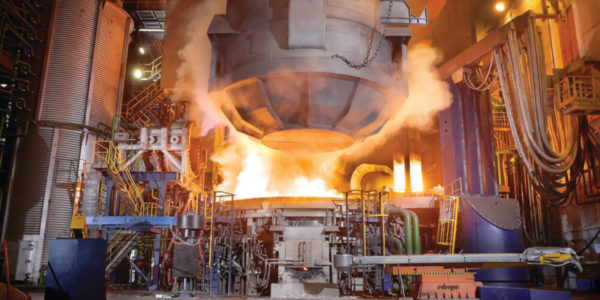
In February 2026, the group confirmed €1.3 billion of investment in Dunkirk for the construction of an electric-arc furnace (EAF), which is scheduled to be commissioned in 2029.
The unit is expected to produce steel with carbon emissions three times lower than a blast furnace.
At the same time, late last April the company announced plans to cut about 600 jobs at ArcelorMittal France North sites, nearly half of them in Dunkirk.
As the statement said, the figure is not final and may change.
The company said the measures were necessary to adapt operations to the new market environment and ensure future competitiveness.
«As the European steel industry faces a crisis marked by a 20% drop in demand over five years and a sharp rise in imports, which now account for 30% of the market, ArcelorMittal France North must constantly review its efficiency and competitiveness,» ArcelorMittal said at the time.
Flawed logic
President of ArcelorMittal France Alain Le Grix de la Salle in his response in June this year described the debate over nationalising the company’s French assets as deeply biased.
«The narrative is aimed at making people believe that ArcelorMittal does not want to invest in decarbonisation or is in the process of leaving France, and that therefore only nationalisation can save French steel,» he noted.
De la Salle recalled that, when announcing investments in Dunkirk, the company explained that decarbonisation of the facilities would be carried out in stages, based on the asset’s model and future demand for carbon-neutral steel.
«It was also stated that there are currently no conditions in Europe for DRI production, given the energy crisis and therefore the price of gas,» the president of ArcelorMittal France said.
Like all European steelmakers, the company is suffering from falling demand and competition, especially from China, he noted.
However, «leaving France» is not on the agenda. The quota system introduced by the EU, together with CBAM, creates new prospects for French and European steel. The real debate today concerns customers and value chains that are under serious threat of relocation or even disappearance.
Last year, in an interview with Franceinfo, Alain Le Grix de la Salle already stressed that nationalisation would in no way solve the problems facing the company. He also explained at the time that ArcelorMittal’s French facilities were being affected by global overcapacity and disruptive imports, especially from Asia.
Current cases
ArcelorMittal is gradually scaling back its presence in less efficient European assets, as falling demand in Europe, high energy costs and intensifying competition from imports reduce the profitability of operations. For the company, closing and selling certain assets is part of portfolio optimisation, reflecting its desire to direct investment to assets with higher returns and better growth prospects.
One recent example is the assets in Bosnia and Herzegovina. In 2025, ArcelorMittal agreed to sell the Zenica steel mill and the Prijedor mining operation to Pavgord Group. The company said it had made efforts to keep these businesses within the group, but following a strategic review concluded that their sale was the best solution.
In addition, ArcelorMittal continues the process of selling the idled steel plant in Hunedoara, Romania. UMB Steel plans to acquire the company’s tangible assets for €12.5 million excluding VAT. The deal was concluded after production was halted in September 2025, which ArcelorMittal attributed to prolonged losses, high energy prices and weak demand in the regional market.
The Italian government no longer has additional financial resources to support troubled steelmaker Acciaierie d’Italia, which was previously part of the ArcelorMittal group. The state took the company under its control in early 2024 after it fell into a deep liquidity crisis that threatened the continued operation of Italy’s largest steel producer.
In South Africa, state-owned Industrial Development Corp (IDC) continues talks on buying a larger stake in ArcelorMittal SA (AMSA) – they have been under way since autumn 2023. AMSA has now shut two steel plants and a mine in the country. The company still operates the Vanderbijlpark plant, which produces steel sheet and other products, and also has currently idle capacity in two other cities.
A different situation developed in Central Asia. In the autumn of 2023, after mine accidents with multiple fatalities, the Kazakh authorities took back ArcelorMittal’s assets. At the time, the group said talks on nationalisation had begun even before the October tragedy at the Kostenko mine, which became the final trigger for state intervention.
In December 2023, ArcelorMittal eventually sold its assets in the country to the state direct investment fund (Qazaqstan Investment Corporation JSC) for $286 million, although it had sought a much higher amount ($3.5 billion). QIC acquired all shares in ArcelorMittal Temirtau and ArcelorMittal Tubular Products Aktau. The new investor was Qazaqstan Steel Group. ArcelorMittal Temirtau was renamed Qarmet.
At the same time, ArcelorMittal is redirecting investment from mature, politically difficult and costly assets to India, which has become one of the company’s key growth destinations. A growing share of capital expenditure is being directed to the Indian market as ArcelorMittal expands production capacity where demand prospects are more favourable and expected investment returns are higher.
Thus, late last year Dilip Oommen, CEO of AMNS India, a joint venture with Japan’s Nippon Steel, said the company aimed to reach steelmaking capacity of 25-26 million tonnes by 2030. Among other things, this includes building a new greenfield facility in Andhra Pradesh state. In March this year, the companies launched its construction. After completion of the first phase, the plant will produce 8.2 million tonnes of steel per year, and 18 million tonnes after the second.
AMNS India intends to invest in the country from 55,000 to 60,000 crore rupees (approximately $6-6.6 billion) over a three-year period – from the 2025/2026 to the 2027/2028 financial years.
Recently, ArcelorMittal Executive Chairman Lakshmi Mittal said that India is poised to become the next major driver of global steel demand.
«The past 20 years have been marked by China’s incredible growth. Now it is India’s turn, with major expansion in infrastructure, rapid growth in urban housing construction and the energy transition on the horizon,» he said.
European steelmakers are now seeing signs of a market improvement amid CBAM and EU safeguard measures. At the same time, experts forecast a decline in steel production in China. Despite this, it is still too early to talk about a new landscape for the global market.
However, efforts to nationalise or take control of troubled steel assets in order to preserve their production potential do not always provide the answer. Such steps, as practice shows, can create additional problems for national governments, notably because of the difficulty of reaching settlements with former owners (the British Steel case) and finding new investors (the failed auctions to sell Liberty Galați, among others). In addition, states have to bear extra costs to keep such enterprises operating.