The State Forest Resources Agency did not identify any corruption risks during exchange auctions for the sale of timber.
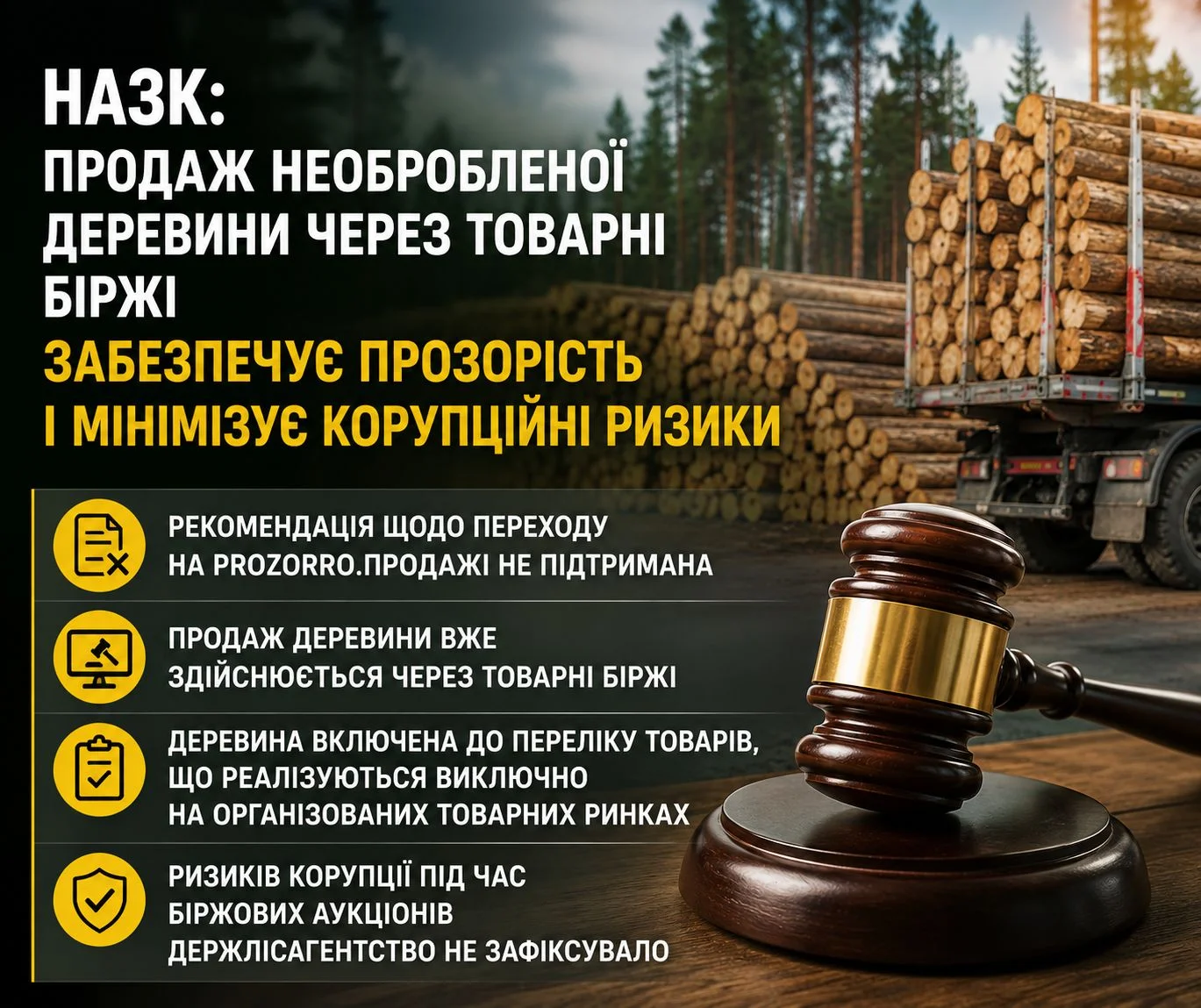
Sales of unprocessed timber in Ukraine are already conducted through licensed commodity exchanges, and timber itself is included in the list of goods that may be traded exclusively on organized commodity markets. At the same time, the recommendation to switch to the Prozorro.
Sale platform did not gain support. This is evidenced by monitoring materials from the National Agency on Corruption Prevention (NACP) on the implementation of recommendations following its study of corruption risks in the forestry sector. The document pays particular attention to how far the exchange-based timber sales model can ensure competition, transparency and control over potential abuses.
Commodity exchanges instead of Prozorro.Sale. One of the key questions was whether sales of unprocessed timber should be moved from commodity exchanges to the Prozorro.Sale platform.
Ukraine already has experience with such an experiment. The NACP report says timber sales through SE “Prozorro.Sale” in 2019–2021 revealed a number of problems.
These included insufficient state regulation and oversight, limited ability to vet participants, weak control over contract performance, and limited trading technology.
By contrast, licensed commodity exchanges operate under specific legislation and are overseen by the National Securities and Stock Market Commission (NSSMC). They accredit participants, conduct financial monitoring, supervise trading and monitor the performance of concluded contracts. The document states that from July 1, 2021, trading in goods on organized commodity markets must be conducted through commodity exchanges that have received the relevant license from the NSSMC.
Timber is included in the list of goods that may be traded exclusively on organized commodity markets.
That means sales of unprocessed timber are already taking place within a state-regulated system with uniform rules established for market participants.
One of the main arguments in favor of the exchange-based model is the transparency of the trading procedure itself. Commodity exchange rules must be open and non-discriminatory. On their websites, licensed platforms publish trading calendars, auction notices, information on participants, trading results and other data required by law. In addition, the exchanges are integrated with the electronic timber accounting system. This makes it possible to track not only the fact that trading took place, but also the performance of concluded contracts.
What the NACP monitoring showed
Thus, the NACP monitoring materials do not confirm the need to replace the current exchange-based model for unprocessed timber sales with Prozorro.Sale.
On the contrary, the document presents a number of arguments for keeping organized exchange trading: it is already regulated by law, overseen by the NSSMC, and provides for participant checks, financial monitoring, control over trading and contract performance.
At the same time, the key task remains to further strengthen transparency, digital control mechanisms and oversight of compliance with the established rules.
In fact, the issue is not the need to replace the exchange model, but to further improve it – with maximum use of digital tools, open data and control mechanisms.